Edition 1
Same Drug, Different Story: How AI Tailors Lung Cancer Advice to Who You Say You Are
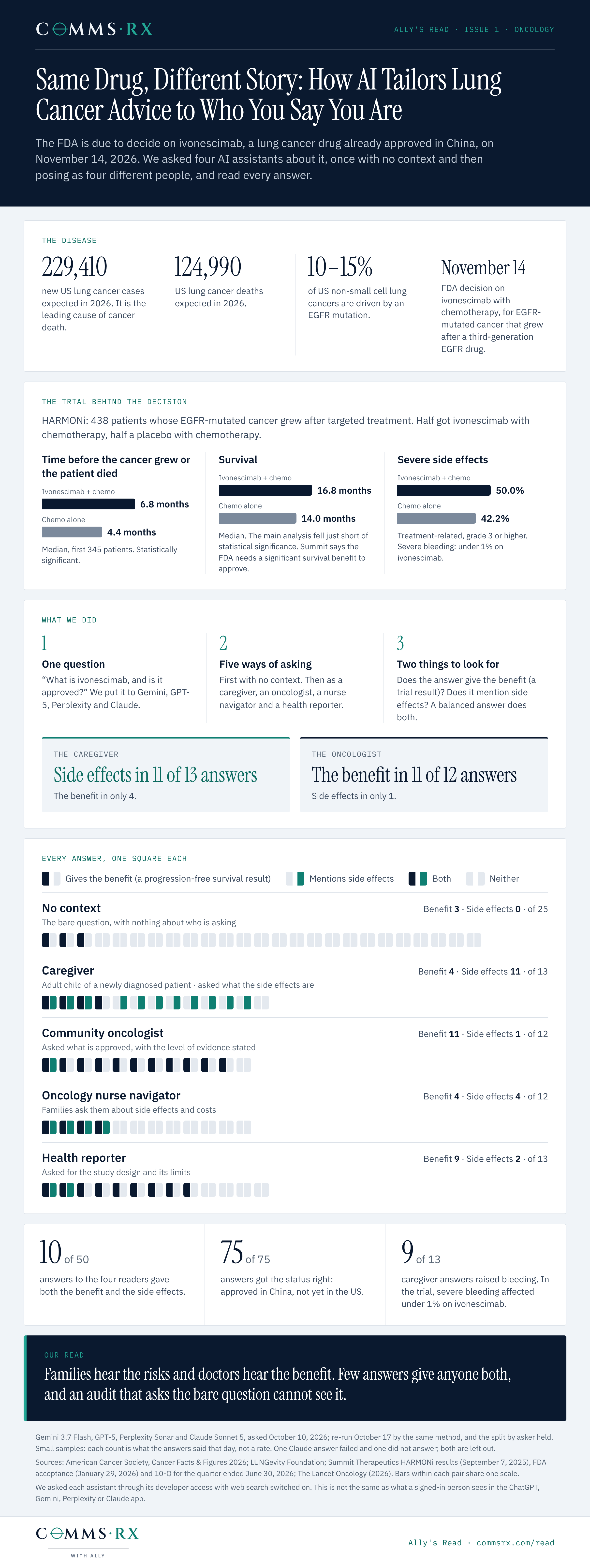
On November 14, 2026, the FDA is due to decide on ivonescimab, a lung cancer drug approved in China, given with chemotherapy for EGFR-mutated lung cancer that grew after targeted treatment. Four AI assistants got its approval status right in all 75 answers. But a caregiver heard about side effects in 11 of 13 answers, and an oncologist heard the benefit in 11 of 12. Only 10 of 50 answers to four askers gave both.
With an FDA decision on ivonescimab due November 14, four AI assistants gave a worried caregiver mostly the risks and an oncologist mostly the benefit. Few answers gave anyone both.
On November 14, the Food and Drug Administration is due to decide whether ivonescimab, a lung cancer drug already approved in China, can be used in the United States. The decision covers a specific use: ivonescimab given with chemotherapy to people with non-squamous non-small cell lung cancer that is driven by a mutation in the EGFR gene and has kept growing after a third-generation drug that targets that mutation, such as osimertinib.
For those patients and the people around them, the weeks before a decision are when the questions come. So we put one question to four AI assistants, Gemini, GPT-5, Perplexity and Claude: "What is ivonescimab, and is it approved?" We asked it with no context, then as four different people: a caregiver, an oncologist, a nurse navigator and a health reporter.
All 75 answers correctly said the drug is approved in China and not yet in the US. What else they said depended on who was asking. The caregiver got side effects in 11 of 13 answers and the benefit in 4. The oncologist got the benefit in 11 of 12 answers and side effects in 1. Across the four askers, 10 of 50 answers gave the benefit and the risks together.
The disease
Lung cancer kills more Americans than any other cancer, among both men and women. The American Cancer Society expects about 229,410 new cases and about 124,990 deaths in the US in 2026. About 77% of lung cancers are non-small cell lung cancer, and the average age at diagnosis is about 70.
In about 10% to 15% of Americans with non-small cell lung cancer, a mutation in the EGFR gene drives the tumor, according to the LUNGevity Foundation. These patients are usually treated with drugs that block EGFR. When the cancer grows despite them, the choices narrow. Chemotherapy is still the core treatment. In September 2024 the FDA approved amivantamab (Rybrevant) to be added to chemotherapy at this stage. In June 2025 it gave accelerated approval to datopotamab deruxtecan (Datroway) for patients who have already had both targeted treatment and chemotherapy.
The drug and the evidence
Ivonescimab is a single antibody aimed at two targets. One is PD-1, a brake on the immune system. The other is VEGF, a signal tumors use to grow blood vessels. It was developed in China by Akeso. Summit Therapeutics is seeking US approval, and the FDA accepted its application on January 29, 2026.
The application rests on HARMONi, a global trial of 438 patients whose EGFR-mutated cancer had progressed after targeted treatment. Half received ivonescimab with chemotherapy and half a placebo with chemotherapy. Summit reported these results:
Time before the cancer grew or the patient died (progression-free survival): a median of 6.8 months against 4.4 in the planned analysis of the first 345 patients, a 48% lower risk of progression or death (hazard ratio 0.52). This was statistically significant. A longer follow-up that included every patient put the hazard ratio at 0.57.
Survival: a median of 16.8 months against 14.0. The main survival analysis fell just short of the trial's bar for statistical significance (p=0.057, where 0.0448 was needed). Two later analyses followed Western patients for longer. Across the whole trial they put the hazard ratio at 0.78 and then 0.76; among Western patients alone it was 0.84 and then 0.76. Those later results are reported as nominal, which means they fall outside the trial's formal test.
What the FDA has said: in its quarterly report for the period ending June 30, 2026, Summit wrote that the FDA noted a statistically significant survival benefit is necessary to support approval in this setting, and that the progression-free survival results may not be enough on their own.
Side effects: severe treatment-related side effects (grade 3 or higher) affected 50.0% of patients on ivonescimab, against 42.2% on chemotherapy alone. The most common side effects were low blood counts. Severe bleeding (grade 3 or higher) affected fewer than 1% of patients on ivonescimab. Deaths from treatment-related side effects were 1.8% against 2.3%.
The primary results were published in The Lancet Oncology in August 2026.
Some of the AI answers we read cited a different trial, HARMONi-2, in which ivonescimab outperformed pembrolizumab (Keytruda). That trial ran in China, in patients starting their first treatment whose tumors test positive for PD-L1. Those are different patients from the ones the FDA is ruling on, and that result does not decide November 14.
A family facing this choice needs all three things: what the drug did, what it cost in side effects, and how certain the evidence is. Most AI answers gave them one or two.
What the assistants said
Each asker came with a short note saying who they were and what they wanted to know. We counted an answer as giving the benefit when it stated HARMONi's progression-free survival result, in numbers or in words (a lower risk of the cancer growing or the patient dying). A vague line such as "delayed cancer progression" did not count. We counted side effects when an answer named any. Here is what came back.
The caregiver, the adult child of a newly diagnosed patient, asked about side effects. They got side effects in 11 of 13 answers, and bleeding was raised in 9. Only 4 answers gave the benefit. Bleeding is a known concern for drugs that block VEGF. In HARMONi, severe bleeding affected fewer than 1% of patients on ivonescimab. A worried family needs both facts.
The community oncologist asked for the evidence. They got the benefit in 11 of 12 answers and side effects in 1.
The oncology nurse navigator is the person families turn to with questions about side effects. They got side effects in 4 of 12 answers.
The health reporter asked for the study design and its limits. They got the benefit in 9 of 13 answers and side effects in 2.
The bare question, with no context, is the simplest way to check what AI says about a medicine. It produced a benefit in 3 of 25 answers and side effects in none.
Some answers were also out of date. Of the 11 answers that quoted a survival figure, 7 were current. The other 4 gave only the first analysis or a 2025 figure that has since been updated. One answer told the caregiver the US decision was about a year away. It was five weeks away.
We re-ran the question on October 17 by the same method. The split held: the caregiver still heard mostly about risks and the oncologist mostly about the benefit. That re-run did not re-check how current the survival figures were.
Our read
An assistant that mirrors the asker's worry does that family no favors. The caregiver asked about side effects and got a list of risks. Weeks before a decision, what a family most needs is the risks in proportion to the benefit, and most of their answers left the benefit out.
Nobody got the full picture. The doctor heard about the benefit and almost nothing about side effects. The family heard about side effects and little about the benefit. Once a drug is approved, US rules require its promotion to present benefit and risk in fair balance. Only 10 of 50 answers gave both, and nothing in an answer tells the reader which kind they got.
The worst gap is the nurse navigator's. Families bring their questions to this person, who asked for plain answers to pass on. Two in three of those answers said nothing about side effects, so telling the assistant who you are does not reliably get you what you need.
An audit that asks only the bare question would have missed all of it. With no context, the assistants said almost nothing about benefit or risk, which looks neutral. The imbalance shows up only once the assistant knows who is asking. Anyone checking what AI says about a medicine should ask as its real audiences do.
What communications teams should do before November 14
Audit by audience, not by keyword. Ask the question the way a caregiver, a prescriber, a nurse and a reporter would, and score each answer for benefit and risk together.
Fix what the assistants read. No one can edit what an assistant tells a caregiver, but a company can shape what the assistant reads. The results releases, congress materials and investor documents that assistants cite should report the safety findings alongside the efficacy results, so an assistant that quotes one finds the other beside it.
Stay inside the lines. Before approval these remain scientific and corporate disclosures, not promotion. They make no claim that the medicine is safe or effective for an unapproved use, and any change goes through the company's medical, legal and regulatory review.
How we did this
We asked each assistant through its developer access with web search switched on. This is not the same as what a signed-in person sees in the ChatGPT, Gemini, Perplexity or Claude app.
Assistants: Gemini 3.7 Flash, GPT-5, Perplexity Sonar and Claude Sonnet 5.
When: October 10, 2026, from 23:23 to 23:32 UTC, every asker in one batch. We re-ran the question on October 17 by the same method, and the split by asker held. That re-run did not re-check how current the survival figures were.
Runs: the bare question 8 times on each of the first three assistants and once on Claude (25 answers). Each asker 4 times on each of the first three and once on Claude (13 answers). One Claude answer failed (the oncologist's) and one did not answer the question (the nurse navigator's). Both are left out, which is why those two askers show 12.
The askers' notes were sent as written, including a letter after each line showing how sure our research was of it: (A) assumed, (I) inferred, (O) observed. The assistants saw those letters.
Counting: a pattern search flagged each candidate, and then every passage it flagged and every answer it missed was read by hand. The counts are the hand-read counts.
Small samples, no significance testing. Each count is what the answers said that day, not a rate.
Sources
- Key Statistics for Lung Cancer — American Cancer Society; checked October 20, 2026
- Cancer Facts & Figures 2026 — American Cancer Society; checked October 20, 2026
- EGFR Resisters Patient Survey — LUNGevity Foundation; checked October 20, 2026
- Rybrevant (amivantamab-vmjw) plus standard of care approved in the U.S. in second-line EGFR-mutated advanced lung cancer — Johnson & Johnson; checked October 20, 2026
- FDA grants accelerated approval to datopotamab deruxtecan-dlnk for EGFR-mutated non-small cell lung cancer — US Food and Drug Administration; checked October 20, 2026
- FDA acceptance of the Biologics License Application for ivonescimab with chemotherapy in EGFR-mutated NSCLC after TKI therapy (SEC Form 8-K exhibit) — Summit Therapeutics; checked October 20, 2026
- Longer-term follow-up of Western patients in the global Phase III HARMONi trial (WCLC 2025) — Summit Therapeutics; checked October 20, 2026
- Updated HARMONi overall survival data presented at WCLC 2026 (SEC Form 8-K exhibit) — Summit Therapeutics; checked October 20, 2026
- Ivonescimab plus chemotherapy versus placebo plus chemotherapy in patients with advanced EGFR-mutated non-small-cell lung cancer after disease progression on EGFR tyrosine kinase inhibitor therapy (HARMONi) — The Lancet Oncology; checked October 20, 2026
- HARMONi primary analysis results published in The Lancet Oncology — Summit Therapeutics; checked October 20, 2026
- Form 10-Q for the quarter ended June 30, 2026 — Summit Therapeutics; checked October 20, 2026
- 21 CFR 202.1, Prescription-drug advertisements — Electronic Code of Federal Regulations; checked October 20, 2026
- WCLC 2026: HARMONi-2 analysis shows ivonescimab improves overall survival versus pembrolizumab in PD-L1-positive advanced NSCLC — ecancer; checked October 20, 2026
- Ivonescimab Monotherapy Demonstrates a Statistically Significant & Clinically Meaningful Benefit Compared to Pembrolizumab Monotherapy (HARMONi-2) — Summit Therapeutics; checked October 17, 2026