

An early
approval
and a better
launch plan
Viv Hart · fictional communications leader
Ally is her AI communications partner.
One week into the job. The approval arrives 28 days early.
Halveron Therapeutics is about to become a commercial company. Its first product, LUMEVRA, is a once-daily oral GLP-1 for chronic weight management. The FDA decision arrives a full month ahead of expectations.
Viv Hart, the new Head of Communications, joined one week earlier. She has inherited an important moment and a compressed timetable. Leadership wants to make the most of the approval. Medical needs the evidence represented precisely. Commercial wants eligible patients and prescribers to understand the new option. Market access and operations still have practical launch questions to resolve.
Her instinct is understandable: one major announcement carrying the approval, the price and access story, supported by a full 360-degree plan. A company gets only one first approval. She wants to make it count.
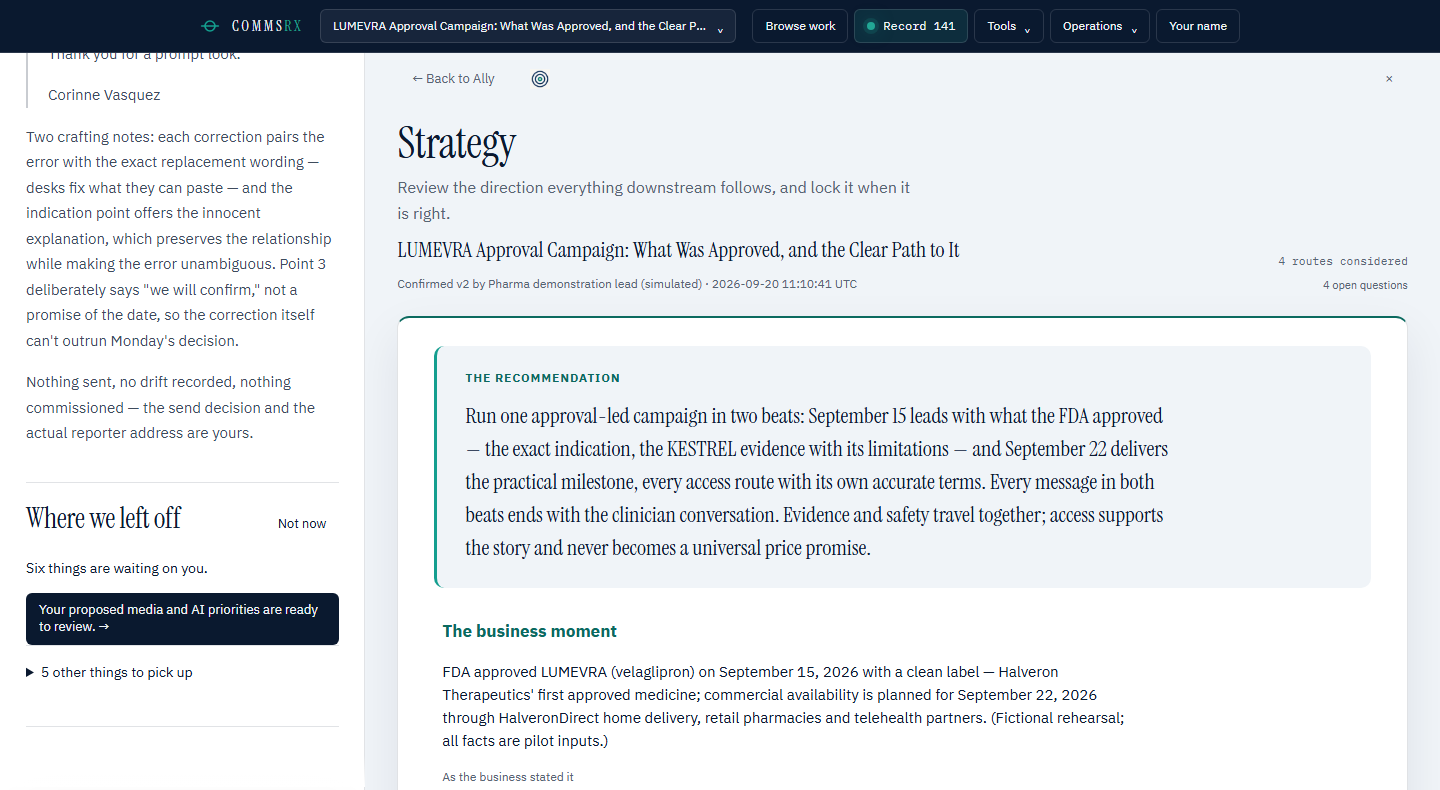
“She asks Ally for help. Ally already has the company and campaign context — the product facts, evidence, access routes and decisions carried forward in the workspace.”CommsRx · Case Narrative
The question that decides everything else.
For this launch strategy, Ally maps the decision from the patient’s perspective. The pivot point is a Tuesday afternoon encounter in an exam room.

TUESDAY · 3:40 PM · THE EXAM ROOM
“What would it cost me?”
“It depends on your plan.
I’m honestly not sure.”
Maria, 47. Her clinician has just raised a new once-daily pill.
AI-GENERATED IMAGE · FICTIONAL PERSONA
Nothing went wrong in that room. Nobody could answer the one question that decides everything else. She has a prescription she may never fill. So she looks it up herself — and finds the standard advice: “These medicines typically cost several hundred dollars a month without insurance.” She closes the tab.
“The cost question is where her decision stalls — and it is a question we can answer using the confirmed access facts.”Ally · Strategic Counsel
Ally challenges the plan. Two announcements, not one.
Ally recommends splitting the communications into two distinct announcements — each with its own job, its own audience, and a different information need to answer.
Earns the approval moment. Explains what the FDA has approved, the indicated population, the supporting evidence and the relevant safety information. Gives journalists and interpreters a clear account of the news. Does not overload with operational details that are not yet confirmed.
Answers the next set of questions. When will LUMEVRA actually be available? How can someone obtain it? Which routes apply, and what might they pay? These answers require confirmed operational details — retail stock, direct enrollment, savings-card activation and telehealth readiness. Operationally dependent; doesn’t travel early.
The distinction also matters when people encounter health information through search and AI-generated answers. The two beats answer different needs: what the evidence and decision mean, then how an eligible person can take the next step. Different framing gives reporters, searchers and AI systems useful material for different questions. It does not guarantee coverage or ranking.
“In this fictional scenario, HalveronDirect offers a $99-per-month medicine-only self-pay route. It is one access option, not everyone’s price. The practical question is whether Maria can understand the next step.”Green Thread Briefing Pack
Spanish-language launch films built for Maria’s world.
The retained Spanish-language availability film brings the access story into Maria’s language. Its English counterpart carries the same fictional scenario. These are actual working drafts, with their source safety language visible.
Fictional drafts for human review, not approved promotional materials. The $99 route covers the medicine; telehealth consultation fees are separate. Clinical suitability, a prescription, route eligibility and terms still apply.
The Green Thread — from business goal to behavior shift.
Every communications decision is anchored to a single strategic through-line that connects the business objective to the intended change in stakeholder behavior.
Maria’s path to month four — every function owns one step.
The Green Thread Briefing maps Maria’s journey from assessment to month four. Each step is owned by a specific function. Every team in the room sees its role in her path.
Put the patient journey in the room.
The Green Thread briefing connects the commercial objective, the audience’s unanswered question and the decisions each function owns. Leadership can see where a communications answer helps — and where access, medical or operational work must follow.
Read the briefing transcript
Transcript of the fictional LUMEVRA demonstration.
Tuesday, 3:40 p.m. In the exam room, a patient named Maria asks a simple question. What would it cost me? Her clinician's answer is, It depends on your plan. I'm honestly not sure. At 3:52 p.m. in the parking lot, she has a prescription she may never fill. Nothing went wrong in that room. Yet no one could answer the one question that determines everything else. 6 hours later at 9:40 p.m. she is at the kitchen table. She turns to the internet, typing. Is there a weight loss pill I can actually afford without insurance? The search results offer generic advice. Costs vary, ask your insurer or talk to your doctor. None of these help her tonight. She closes the tab. The truth is, the price she needed already existed. It was $99 a month, flat for every strength with home delivery. Nobody told her, not her doctor, and not the pharmacy. Our proposal is to answer her question before she has to ask it. By leading with predictable access and practical information, we move past the hurdles where patients currently stall. Every function in this room owns one of her steps. From her initial assessment to her fourth month, the dots on this map represent where she currently gets stuck. We can fix this. Let's look at Maria's context. You can change her variables like her coverage or language to see how she responds. This tool helps us refine our approach, not replace actual research. A common concern is whether promoting a cash price will weaken our payer position. We position this as an alternative for those without coverage, not a replacement. You will approve the messaging first. To move forward, we need one commitment from each function in this room. These small targeted actions will ensure that the next time Maria asks, someone is ready with an answer. It's Wednesday morning. Next time she asks, we can ensure everyone she meets has the answer. Let's make that possible.
Ally reads the landscape before she shapes a word.
For this fictional launch, Ally applies four structured research pathways. She maps the shape of the decision system, identifies what each audience still needs, reads how the competition has positioned, and finds the white space worth standing on.
Ally maps how the prescribing decision is actually made: which specialists initiate, which PCPs continue, which payer policies gate access, and which clinical guidelines create or close windows for LUMEVRA. She identifies whose judgment shapes the prescribing and access decisions, and which audiences the strategy must reach.
Ally maps the specific informational and practical gaps for each audience. For clinicians: a precise account of the evidence and its limits. For patients: a clear cost answer before they leave the exam room. For payers: comparative benefit data. Unmet needs define the work; Ally doesn’t fill them with generic messaging.
Ally reads the existing narrative landscape across GLP-1 competitors: the claims they’ve staked, the evidence they’ve led with, the patient archetypes they’ve built around, and the spaces they’ve left unclaimed or underserved. She identifies where differentiation is real and defensible versus where the field is already saturated.
With the decision system mapped, unmet needs identified, and the competitive field read, Ally identifies the white space that best serves the business goal while aligning with LUMEVRA’s clinical differentiators and Halveron’s positioning constraints. For LUMEVRA: helping people whose cost uncertainty stops the clinical conversation understand the next step. A price alone is not durable differentiation; the access story needs current competitive research and clear route conditions.
Three systems. One connected intelligence.
Ally’s cognition is built on three interlocking systems: memory that compounds over time, approved meaning linked to its expressions, and a learning cycle that carries useful observations into the next assignment.
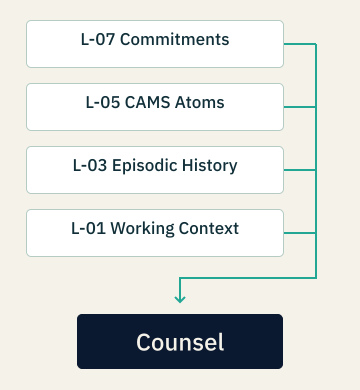
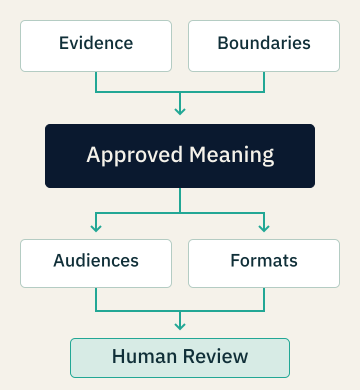
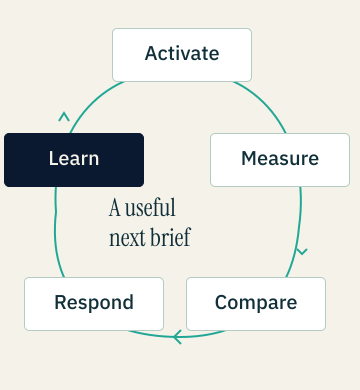
Ally separates strategic counsel from asset execution. In this launch, counsel establishes the direction; Writer and Asset Studio carry it into the work with the relevant message records, evidence and limits. People review and approve release. A smaller assignment can start with the work it needs, without a mandatory strategy exercise.
Three signals. Three different responses.
As the launch travels, Ally monitors the environment and categorizes signals by their required response. Not every signal warrants action. The discipline is knowing which does.
Patients are delaying appointments because they think they must resolve cost and access before discussing clinical suitability. The record needs a proactive clarification through trusted clinical voices. Ally drafts the response for medical review.
A trade publication article states LUMEVRA has been approved for type 2 diabetes. This is factually wrong — the approved indication is chronic weight management. Ally prepares a factual correction for the publication and checks later coverage and AI answers. CommsRx cannot directly change an external system’s retrieval corpus.
A skeptical but accurate piece questions affordability program durability. The coverage is unflattering but contains no factual errors. Ally recommends monitoring only. A public response would amplify the question without resolving it.
A coherent strategy, carried through.
This fictional launch rehearsal shows how a lean in-house team can connect the objective, counsel, messages, outputs and follow-up during a compressed approval window. It is a demonstration of the work, not a customer outcome claim.
“CommsRx connects strategic counsel, approved meaning, tailored execution and learning so a lean in-house team can carry a coherent strategy through a demanding launch.”LUMEVRA Master Case Study · Signal Fidelity Group