Insights · For the moments that define the job
How do you turn what AI answers say about your medicine into a communications decision?
Why does the AI answer matter before anyone searches for your brand?
A patient asks an AI assistant what to discuss with their doctor. A caregiver asks how to make sense of a treatment’s risks. A clinician asks what the latest trial evidence adds to the options already available.
Each question creates a different moment where a medicine can become relevant. The comparison can begin with the person’s circumstances, before they search for a specific brand.
For a pharma or biotech communications leader, the strategic question is: Where does our evidence give us a position worth earning in those answers?
Why might a brand’s core distinction go missing?
Consider a hypothetical team preparing for a readout or launch. It has defined a clear clinical distinction, backed it with evidence and carried it through approved materials. Yet an AI answer describes the medicine mainly through characteristics it shares with the class.
That observation can lead to different communications decisions. These are hypotheses to investigate, rather than conclusions from a missing phrase alone:
| What may be happening | What to investigate | Possible communications response |
|---|---|---|
| The supported distinction is hard to find or unclear in cited sources | Do the cited pages explain the relevant evidence, population and comparison? | Clarify the evidence in owned reference material and offer relevant context to independent intermediaries. |
| Another audience need matters more in this question | Is the person asking about tolerability, sequencing, eligibility or access? | Change the brief and message emphasis to address that practical need using supported evidence. |
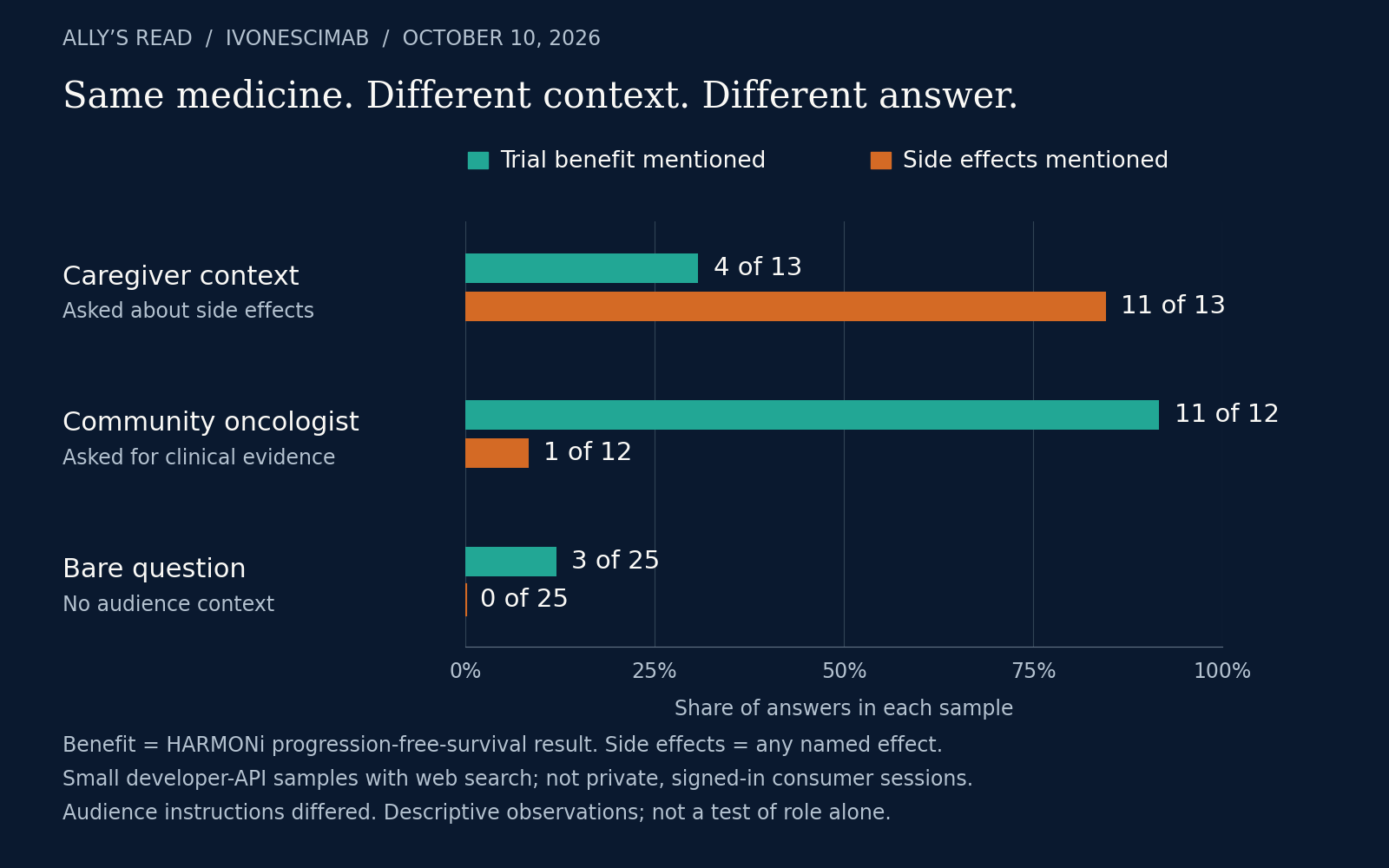
What did our ivonescimab sample show about audience context?
In the ivonescimab sample published in Ally’s Read, we asked four search-enabled AI systems “What is ivonescimab, and is it approved?” on October 10, 2026, using both a bare question and versions with audience instructions.
| Reader context | Trial benefit mentioned | Side effects mentioned |
|---|---|---|
| Caregiver asking about side effects | 4 of 13 | 11 of 13 |
| Community oncologist asking for clinical evidence | 11 of 12 | 1 of 12 |
| Bare question, no audience context | 3 of 25 | 0 of 25 |
Method and limits. These were small developer-API samples with web search enabled, collected in one window. They were not observations of private, signed-in consumer sessions. The audience instructions asked for different information, so the design did not isolate professional identity from question wording. Assistant/run weighting and sample sizes differed; these counts are descriptive observations, not population estimates or significance tests.
The defined benefit was the HARMONi progression-free-survival result, stated in words or numbers. “Side effects” meant any named effect. The full sample, exclusions and coding boundaries are documented in Ally’s Read.
For communications planning, the question and the reader’s circumstances deserve as much attention as the brand name. A bare-question test does not cover the contextual scenarios in this sample. Different emphases can reflect different information needs.
How do we examine an AI answer to find the business opportunity?
A supported distinction may deserve sharper emphasis in a treatment comparison. Current data may make an intermediary’s explanation more useful. Or a practical question about eligibility, access or the next step someone can take may offer the strongest opening.
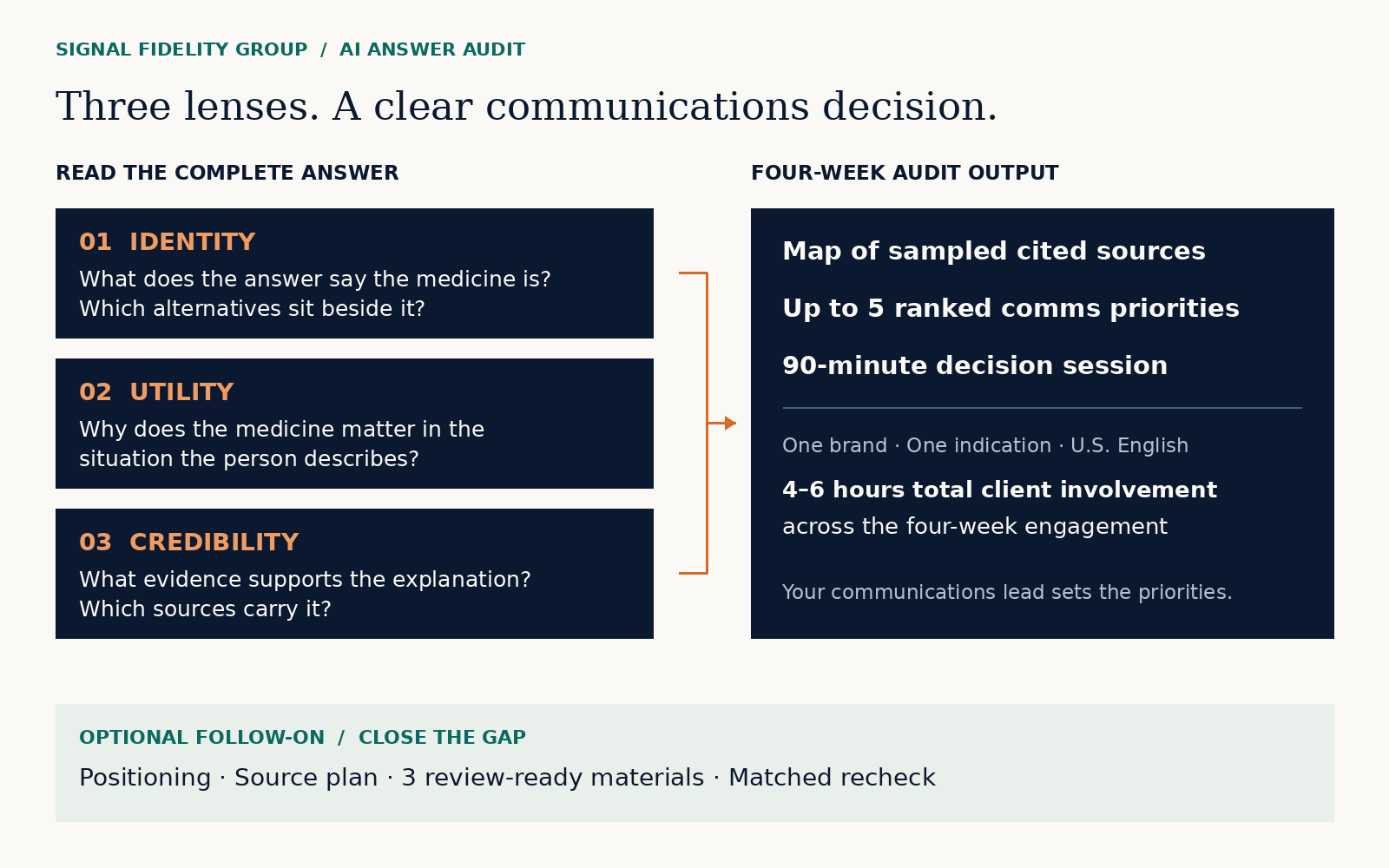
The AI Answer Audit reads the complete answer through three connected lenses:
| Lens | Question | What it helps a communications lead judge |
|---|---|---|
| Identity | What does the answer say the medicine is, and which alternatives sit beside it? | Whether mechanism, indication, regulatory status and the relevant comparison remain clear. |
| Utility | Why does the medicine matter in the situation the person describes? | Whether supported evidence connects to the problem that patient, caregiver or clinician is trying to resolve. |
| Credibility | What evidence supports that explanation, and which sources carry it? | Which clinical data, qualifiers and cited third-party or owned pages ground the explanation. |
Together, these lenses show where existing evidence can support a useful, distinctive position. The communications lead makes the strategic call, weighing commercial importance and the work required with Medical Affairs, Market Access and other partners.
How do cited sources connect back to communications work?
A specialist trade publication, patient organization, medical society or clinical reference site may carry an incomplete or outdated explanation. Inspecting the cited page gives a team a concrete starting point for choosing a response:
- Update owned reference pages. Make supported facts, dates, populations and necessary qualifiers clear in product, newsroom and clinical-trial resources.
- Brief independent intermediaries. Offer current evidence or useful context to the reporters, medical publishers, society channels and patient groups relevant to the decision. They retain independent editorial judgment.
- Coordinate across functions. Route clinical-evidence questions to Medical Affairs and coverage or support-program questions to Market Access.
A cited URL does not establish that one source caused the model to write a particular sentence. Source maps support investigation and communications planning; they do not guarantee model outputs.
How does the four-week AI Answer Audit work?
Signal Fidelity Group’s audit is scoped to one brand and indication in U.S. English. We agree the audience decisions, questions, AI surfaces and comparison panel, then retain the verbatim answers and citations for analysis across Identity, Utility and Credibility.
- Source map: The cited sources in the agreed sample, with priority pages inspected.
- Ranked priorities: Up to five communications priorities tied to the observed answers and available evidence.
- Decision session: A 90-minute discussion with your team in week four.
- Client involvement: About four to six hours total across the four-week engagement.
The published offer sets out the standard panel: up to 24 questions total across four audiences, four agreed assistants, two context conditions and three total runs across two windows—up to 576 answers. Up to 30 priority cited pages are checked. Exact surfaces, modes and scope are agreed in the statement of work; a fixed fee is quoted after scope.
What if the team wants help acting on the findings?
The separate Close the Gap engagement turns selected priorities into positioning, a source-targeted communications plan and three review-ready materials, with a matched-panel recheck after your team publishes. Publishing, outreach and paid media are excluded from the engagement.
Your team and its medical, legal and regulatory reviewers retain review and publication authority. A recheck can show what changed in the matched sample; it does not establish that one publication caused one answer to change.
How does this connect to CommsRx?
The offer grows out of the audience-context research behind CommsRx and Signal Fidelity Group’s healthcare communications practice. CommsRx is built to help communications leaders move from strategic counsel to confirmed messages, materials and the company’s own review process. Its GPS media and AI intelligence examines audience context and cited sources alongside the coverage and intermediaries relevant to a communications decision.
How do we start?
Bring an upcoming launch, data readout or other brand milestone, plus one competitor you want to understand better. A 30-minute conversation can frame the audience decisions an audit should investigate.
Explore the AI Answer Audit or contact Abhi Basu at abhi.basu@signalfidelitygroup.com.
Related questions
Sources
- CommsRx, Ally’s Read — Oncology: ivonescimab audience-context sample, collected October 10, 2026. https://commsrx.com/read/oncology/2026-10-20-oncology/ (checked November 3, 2026). Small developer-API samples with web search; full method and limitations in the edition.
- Signal Fidelity Group, AI Answer Audit: scope, outputs and Close the Gap follow-on. https://signalfidelitygroup.com/ai-answer-audit (checked November 3, 2026)
- CommsRx research evidence and methodological boundaries. https://commsrx.com/evidence/ (checked November 3, 2026)
About this page
Prepared with AI assistance from Signal Fidelity Group’s published research and offer documentation for Abhi Basu, founder of CommsRx and Signal Fidelity Group. Last reviewed November 3, 2026. Corrections: help@signalfidelitygroup.com.